Physical Address
304 North Cardinal St.
Dorchester Center, MA 02124
Physical Address
304 North Cardinal St.
Dorchester Center, MA 02124

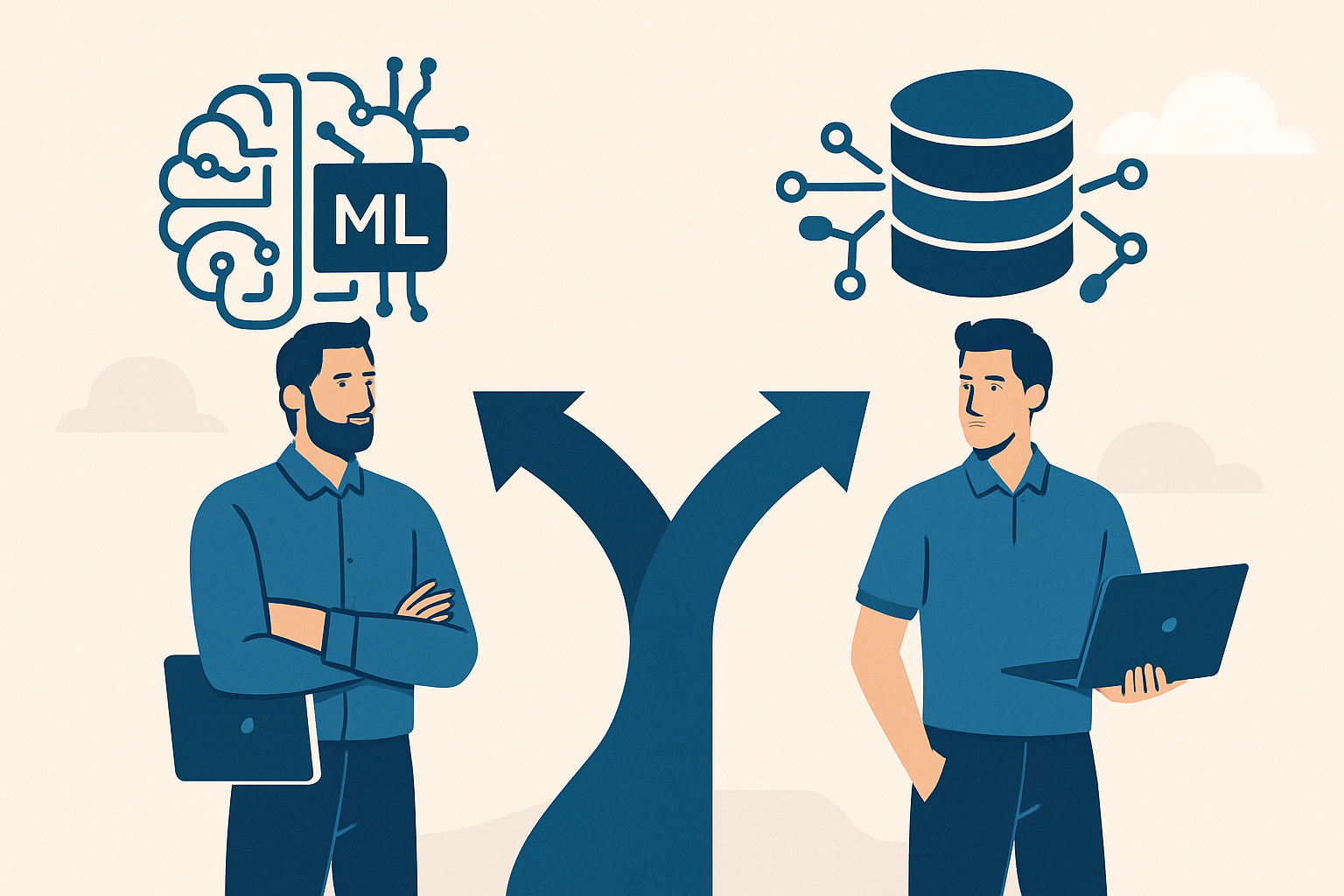
AI Engineering vs. Data Engineering: Which Career Path Is Right for You? AI engineering and data engineering serve distinct but interconnected roles in modern t...
AI engineering and data engineering serve distinct but interconnected roles in modern technology teams. An AI engineer designs, trains, and deploys machine learning models while optimizing inference pipelines and integrating generative AI systems into production environments. A data engineer builds and maintains scalable data infrastructure, designs ETL architectures, and ensures that high quality datasets are available for analytics and model training. The primary difference comes down to focus. Ai vs data engineering boils down to whether you prefer architecting intelligent applications that learn from data or constructing the foundational pipelines that make machine learning possible in the first place. Both roles command premium compensation, experience rapid adoption across industries, and offer clear upward mobility. Your decision should align with your technical preferences, long term goals, and the specific problems you want to solve at scale.
Last Reviewed: May 18 | Sources: DrJobPro AI Hub Data, Industry Reports 2026
Key Takeaways
* AI engineers focus on model development, fine tuning, deployment, and system integration for production grade machine learning workloads
* Data engineers specialize in pipeline architecture, data warehousing, governance, and infrastructure that feed reliable data to downstream teams
* Compensation varies by region and seniority, with mid level professionals earning between $90,000 and $180,000 annually across major global markets
* An effective ai career path requires both formal project documentation and deployed portfolio artifacts that demonstrate measurable business impact
* Organizations are increasingly consolidating hybrid roles, making cross functional literacy in databases, cloud platforms, and ML frameworks essential for advancement
The distinction between these two disciplines becomes clearest when examining their primary objectives. Artificial intelligence engineering revolves around modeling, experimentation, and operationalizing algorithms. Engineers in this track spend their time selecting architectures, hyperparameter tuning, validating model performance against real world metrics, and orchestrating deployment through containerization and orchestration tools. They routinely collaborate with product managers, data scientists, and DevOps teams to ensure that predictions remain accurate, latency stays within acceptable thresholds, and compliance standards are met.
Data engineering, by contrast, centers on reliability, throughput, and accessibility. Professionals in this track design streaming and batch processing frameworks, implement schema evolution strategies, enforce data quality rules, and optimize storage layers across cloud environments. Their output is not a trained algorithm but a trusted dataset that meets SLA requirements for freshness, accuracy, and consistency. Without robust data pipelines, machine learning initiatives fail due to drift, bias, or computational bottlenecks.
AI engineering transforms experimental prototypes into production ready systems. This involves converting Jupyter notebooks into modular codebases, implementing CI/CD workflows for model versioning, and establishing monitoring dashboards that track concept drift and performance degradation. Practitioners work extensively with orchestration platforms like Apache Airflow, Kubernetes, and cloud native serving endpoints. They also manage compute allocation, cost optimization, and load balancing to ensure that inference services remain stable under variable traffic patterns. As organizations adopt foundation models and agentic workflows, AI engineers increasingly handle prompt engineering, retrieval augmented generation pipelines, and tool calling mechanisms that allow models to interact with external APIs securely.
Data engineering establishes the plumbing that makes intelligence possible. Professionals construct lakehouse architectures, implement automated data validation checks, and build incremental update strategies that reduce refresh costs. They design identity resolution logic, manage metadata catalogs, and enforce role based access controls to protect sensitive information. Modern data engineers also bridge traditional relational systems with vector databases, enabling semantic search and embedding retrieval for generative applications. Their work directly impacts query performance, storage efficiency, and regulatory compliance across financial, healthcare, and public sector operations.
The overlap between these fields exists primarily around infrastructure literacy. Both disciplines require proficiency in Python, SQL, version control, and cloud computing platforms. However, the divergence emerges in daily problem solving. An ml engineer vs data engineer conflict typically surfaces during project handoffs when model performance drops due to upstream data quality issues or when pipeline latency prevents timely feature updates. Successful organizations mitigate friction by establishing shared observability standards, defining clear ownership boundaries, and rotating engineers through cross functional rotations to build mutual understanding.
Understanding day to day workflows helps clarify which environment aligns with your working style. AI engineering demands continuous experimentation, rapid iteration cycles, and close collaboration with domain experts who validate model outputs. Data engineering requires methodical planning, rigorous testing protocols, and deep focus on system reliability under heavy loads.
Professionals entering either track will encounter overlapping toolchains. Common foundations include Linux command line navigation, Git version control, Docker containerization, and Terraform or Pulumi for infrastructure as code. AI engineers extend this stack with PyTorch, TensorFlow, Hugging Face Transformers, LangChain, and model evaluation frameworks like MLflow or Weights & Biases. Data engineers lean toward Apache Spark, dbt, Kafka, Flink, Snowflake, BigQuery, Redshift, and data governance platforms like Collibra or Amundsen. Cloud providers supply managed alternatives such as AWS SageMaker, Vertex AI, Azure Machine Learning, Databricks Lakehouse, and Synapse Analytics. Mastery of any single platform rarely guarantees employability. Employers prioritize candidates who can translate concepts across ecosystems and debug failures spanning multiple layers.
Enterprise deployments follow standardized lifecycle phases. Raw inputs enter ingestion queues, undergo cleaning and transformation, then flow into feature stores or reporting warehouses. AI engineers consume features to train baseline models, run A/B experiments, and promote winning configurations to staging environments. Data engineers maintain the routing logic, implement backup strategies, and ensure audit trails meet regulatory standards. When incidents occur, root cause analysis reveals whether the failure originated in training data contamination, pipeline scheduling conflicts, GPU memory exhaustion, or network timeouts. Clear logging conventions and centralized dashboards reduce mean time to resolution across both tracks.
Compensation structures reflect skill scarcity, regional economic priorities, and organizational maturity. The Middle East continues expanding its digital transformation budgets, particularly in Saudi Arabia, the UAE, Qatar, and Oman. Public sector initiatives, fintech scaling, logistics optimization, and healthcare digitization drive sustained hiring across both disciplines.
| Role Level | Typical Experience Range | Average Base Salary (USD) | Primary Location Hubs | Key Certification Preferences |
|---|---|---|---|---|
| Junior Data Engineer | 0 to 2 years | $70,000 to $95,000 | Dubai, Riyadh, Doha | AWS Certified Data Analytics, Microsoft DP-203 |
| Mid Level Data Engineer | 2 to 5 years | $95,000 to $140,000 | Abu Dhabi, Jeddah, Manama | GCP Professional Data Engineer, Databricks Associate |
| Senior Data Engineer | 5+ years | $140,000 to $185,000 | Kuwait City, Muscat, Bahrain | SnowPro Core, Apache Spark Specialist |
| Junior AI Engineer | 0 to 2 years | $80,000 to $105,000 | Dubai, Riyadh | Azure AI Engineer Expert, NVIDIA DLI Certifications |
| Mid Level AI Engineer | 2 to 5 years | $110,000 to $160,000 | Abu Dhabi, Doha | TensorFlow Developer, AWS Machine Learning Specialty |
| Senior AI Engineer | 5+ years | $160,000 to $210,000 | Riyadh, Jeddah, Qatar | Kubernetes CKA, LLM Ops Specializations |
Market dynamics show steady year over year growth for both tracks. Enterprises prioritize candidates who combine coding proficiency with domain awareness. Healthcare institutions require HIPAA aligned data handling alongside predictive triage models. Financial groups demand explainable AI combined with fraud detection pipelines. Logistics networks need real time routing optimization paired with warehouse data synchronization. Alignment between technical capability and industry context consistently outperforms pure credential stacking.
Securing interviews requires more than coursework completion. Recruiters evaluate demonstrable impact, architectural thinking, and communication clarity. A well structured ai career path balances technical depth with business translation skills.
Portfolio artifacts must showcase end to end delivery rather than isolated notebook exports. Successful candidates host publicly accessible repositories containing documented problem statements, data sourcing methods, preprocessing steps, model selection rationale, evaluation metrics, and deployment instructions. Including ablation studies, error analysis tables, and latency benchmarks signals mature engineering discipline. For generative applications, demonstrating RAG implementation, hallucination mitigation techniques, and cost tracking adds measurable value. Hosting inference endpoints on free tiers or academic credits allows evaluators to test functionality directly. Adding README files that explain tradeoffs between accuracy, speed, and budget demonstrates strategic thinking beyond raw code submission.
Interview processes typically span four stages. Technical screenings assess algorithmic reasoning and system design fundamentals. Coding tests evaluate proficiency in data manipulation, API integration, and performance optimization. Architecture rounds examine scalability planning, fault tolerance, and security considerations. Behavioral assessments verify collaboration habits, conflict resolution, and stakeholder management. Preparing case studies that mirror actual enterprise challenges yields stronger outcomes than memorized interview templates. Recording yourself explaining complex concepts aloud improves clarity during live whiteboarding sessions. Requesting mock evaluations from senior practitioners identifies blind spots before formal interviews begin.
Professional networks and specialized boards accelerate placements significantly. Companies seeking verified expertise prefer platforms that validate credentials, showcase project history, and streamline contract negotiations. Evaluating multiple listings simultaneously reveals market expectations, remote work policies, and sponsorship availability. Maintaining an updated profile with consistent activity increases visibility among recruiters scanning emerging skill clusters. Participating in open source contributions, publishing technical analyses, and speaking at regional meetups establishes authority beyond resume submissions. Sustainable growth requires periodic reassessment of emerging tools, shifting regulatory landscapes, and evolving customer requirements.
When to Choose Data Engineering Over Artificial Intelligence
Certain work styles align naturally with infrastructure focus. Individuals who prefer deterministic outcomes, enjoy optimizing query performance, and thrive on systematic troubleshooting typically excel in data engineering. If you derive satisfaction from designing self healing architectures, reducing storage costs, and ensuring uninterrupted data flow for analytics teams, this track provides immediate feedback loops and clear success metrics. Data engineering also offers earlier entry points for computer science graduates and bootcamp alumni since foundational database knowledge translates quickly to cloud environments. Long term progression often leads to principal engineering roles, data architecture leadership, or conversion to AI infrastructure specialization.
When to Pivot Toward Machine Learning and Generative AI
Innovation chasing suits those comfortable with ambiguity and experimental workflows. Artificial intelligence engineering rewards curiosity, continuous learning, and comfort with rapidly shifting benchmark standards. If you enjoy publishing research summaries, fine tuning foundation models for niche applications, and debugging non deterministic behavior, this discipline provides frequent intellectual stimulation. The field attracts professionals from mathematics, statistics, cognitive science, and software development backgrounds because transferable analytical skills dominate initial hiring decisions. Advancement typically moves toward staff engineering, ML operations leadership, or product focused AI strategy roles. Many engineers eventually transition between tracks as projects mature from prototype to production.
Can I transition from data engineering to artificial intelligence engineering later?
Yes. Transitioning is common and often advantageous. Data engineers already understand feature engineering, data distribution shifts, and pipeline reliability. By adding model training frameworks, evaluation methodologies, and deployment orchestration skills, former data engineers frequently become strong AI engineering candidates. Many organizations actively sponsor internal mobility programs that reward cross functional expertise.
Which role has better remote work availability in the Middle East?
Both tracks offer flexible arrangements, though AI engineering currently reports slightly higher remote compatibility due to distributed research collaborations and cloud native development workflows. Data engineering teams sometimes require closer coordination with on prem infrastructure migrations or localized compliance audits. Hybrid models remain the dominant arrangement across most enterprises.
How important is mathematics for someone pursuing an ai career path?
Foundational calculus, linear algebra, and probability statistics significantly improve model interpretation and debugging capabilities. You do not need advanced degree level theory to begin working, but comfort with gradient descent mechanics, regularization techniques, and distribution analysis accelerates progression past junior levels. Practical coding proficiency often compensates for theoretical gaps during initial hiring phases.
Will automation replace either role in the next five years?
Task automation will increase, but full replacement remains unlikely. Routine pipeline maintenance and basic model scaffolding will become more standardized through platform abstractions. Complex architecture decisions, cross team alignment, regulatory navigation, and novel problem solving will continue requiring human judgment. Professionals who adapt to higher level orchestration responsibilities typically advance rather than face displacement.
Should I obtain certifications before applying for mid level positions?
Certifications strengthen applications but rarely substitute for demonstrable project experience. Employers prioritize candidates who can discuss tradeoffs, share production incident responses, and reference measurable improvements. Targeted credentials that align with your chosen cloud provider or data platform enhance credibility during screening phases. Combining certification preparation with hands on lab exercises yields the strongest outcomes.
The intersection of artificial intelligence and data infrastructure continues reshaping how organizations operate. Clarifying your preferred workflow, documenting tangible project results, and engaging with specialized recruitment channels creates a sustainable trajectory. Whether you architect intelligent systems or secure the pipelines that power them, technical excellence combined with strategic positioning determines long term success. Explore current opportunities and connect with verified employers looking for skilled professionals by visiting https://www.drjobpro.com/ai-hub/talent today.