
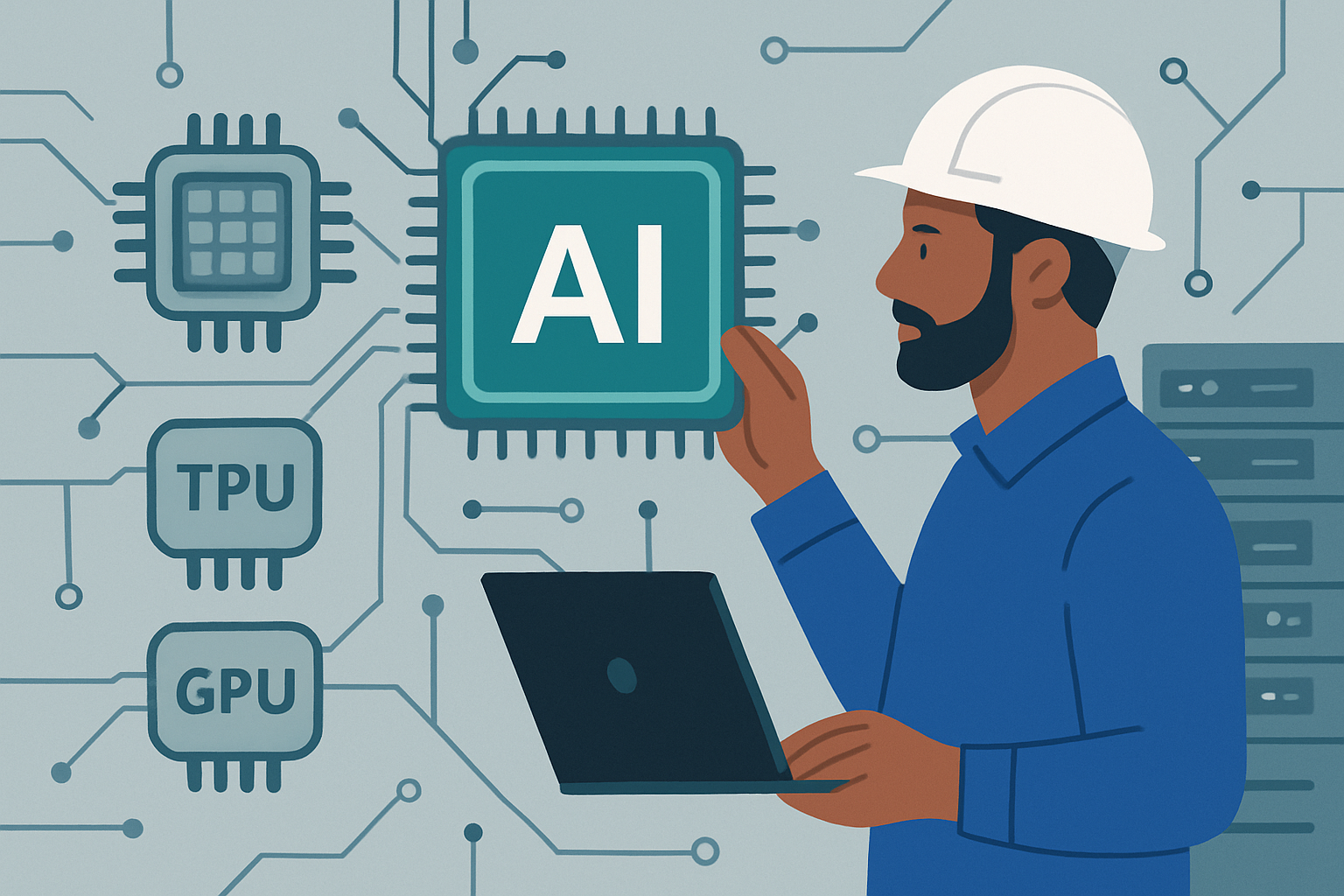

AI Hardware Race: New Chips, New Opportunities for AI Infrastructure Engineers
AI Hardware Race: New Chips, New Opportunities for AI Infrastructure Engineers
The global AI hardware race has accelerated with the commercialization of next-generation semiconductor architectures engineered specifically for high-throughput large language model training and low-latency inference operations. Leading cloud providers and technology conglomerates are deploying bespoke ai hardware ecosystems that demonstrate measurable performance advantages over legacy general-purpose computing nodes, generating immediate labor market friction for qualified specialists. This pivot toward purpose-built ai chip deployment is fundamentally altering recruitment strategies, as enterprises prioritize candidates who possess hands-on expertise in scaling distributed tensor processing across heterogeneous compute fabrics. The resulting demand centers on the tpu gpu engineer profile, a hybrid role requiring mastery over both proprietary accelerator instruction sets and open-source framework interoperability to maximize cluster utilization rates. Within the Middle East, rapid infrastructure expansion driven by sovereign digital transformation mandates has localized this opportunity, positioning regional hubs as critical nodes for AI compute deployment while driving double-digit salary inflation for professionals capable of architecting resilient, energy-efficient AI data center operations.
- Surge in Specialized Hiring: Deployment of custom silicon and optimized accelerators is driving a sharp increase in demand for infrastructure engineers proficient in heterogeneous compute orchestration.
- Regional Market Growth: Middle Eastern data center investments are creating localized career pathways with salary premiums exceeding global averages due to competitive scarcity of verified talent.
- Role Evolution: Traditional system administration is merging with machine learning operations, elevating the importance of the tpu gpu engineer in bridging hardware capabilities with software efficiency.
- Skill Prioritization: Expertise in interconnect protocols, memory hierarchy optimization, and power-aware scheduling now correlates directly with top-tier compensation packages.
- Data-Driven Insights: DrJobPro analytics indicate a 42 percent year-over-year rise in job requisitions requiring validation experience across multi-vendor ai chip environments.
Last Reviewed: May 17 | Sources: DrJobPro AI Hub Data, Industry Reports 2026
The Evolution of Dedicated AI Silicon and Compute Demands
The trajectory of artificial intelligence compute is moving decisively away from monolithic GPU clusters toward integrated systems that combine CPUs, GPUs, TPUs, and FPGAs within unified racks. This consolidation stems from the escalating computational complexity of transformer-based models and the economic pressure to reduce cost-per-token during inference. Companies are now investing billions in vertical integration, designing silicon that addresses specific bottlenecks such as memory bandwidth limitations and communication overhead between nodes. For infrastructure teams, this evolution requires a complete redesign of workload distribution logic. Engineers must evaluate how different ai hardware components interact under varying load conditions, ensuring that peak throughput aligns with service level objectives without exceeding thermal or power envelopes.
Custom ASICs Versus General-Purpose GPUs in Enterprise Deployments
Related: Software Engineer Salary in Saudi Arabia 2026 — Co
Enterprises face a strategic decision when constructing AI pipelines regarding the balance between flexible general-purpose graphics processing units and application-specific integrated circuits. General-purpose GPUs offer broad compatibility and rapid prototyping capabilities, making them suitable for research environments and diverse model architectures. Conversely, custom ASICs deliver superior performance per watt for fixed workloads, providing significant return on investment for scaled production deployments where model definitions remain stable. Infrastructure leaders are increasingly adopting hybrid strategies, utilizing flexible GPUs for experimentation and dynamic routing while routing bulk training jobs to specialized accelerators. This hybrid approach necessitates personnel who can manage abstraction layers seamlessly, abstracting the underlying silicon differences from application developers while maintaining granular control over resource allocation and fault tolerance mechanisms.
The Rise of Inference-Optimized Architectures
Training has historically dominated the AI hardware conversation, but inference now accounts for the majority of operational expenditure as models transition to production. New silicon generations emphasize dense matrix multiplication capabilities combined with advanced quantization support for lower precision formats such as FP8 and INT4. These optimizations enable models to serve millions of concurrent requests while reducing latency to single-digit milliseconds. The shift toward inference-heavy workloads is reshaping hardware procurement cycles and maintenance routines. Teams must implement aggressive cache management strategies and leverage sparse computation techniques to maximize effective throughput. Professionals skilled in profiling inference bottlenecks and tuning kernel executions for specific accelerator microarchitectures are becoming indispensable assets for customer-facing applications requiring consistent reliability.
High-Demand Roles Emerging from the Hardware Acceleration Wave
The acceleration of silicon innovation is expanding the definition of infrastructure engineering beyond traditional server management. Organizations are seeking practitioners who understand the intersection of physics and code, capable of translating hardware specifications into operational excellence. The market reward for this convergence is substantial, with compensation structures reflecting the rarity of individuals who possess deep architectural intuition alongside robust coding proficiency.
Defining the Modern TPU GPU Engineer Profile
Related: Software Engineer Jobs In Riyadh
The title tpu gpu engineer represents a critical nexus in the current labor market. This role demands fluency across multiple accelerator paradigms, requiring engineers to optimize models for execution on tensor processing units from one vendor while simultaneously harnessing the massive parallelism of GPU arrays from another. Proficiency involves configuring collective communication libraries to minimize synchronization delays and debugging divergence errors that arise when distributing tensors across non-uniform memory access domains. Successful candidates demonstrate the ability to conduct end-to-end performance audits, identifying inefficiencies in data loading pipelines that bottleneck even the fastest ai chip implementations. They also collaborate closely with firmware teams to ensure that low-level driver updates do not disrupt established training schedules or introduce stability regressions in long-running jobs.
Bridging the Gap Between Chip Design and MLOps
Infrastructure success depends on tight feedback loops between hardware architects and machine learning operations practitioners. Engineers act as translators, conveying real-world performance telemetry back to design teams while implementing MLOps practices that respect hardware constraints. This includes establishing automated regression tests for silicon variants, managing versioned container images compatible with specific runtime environments, and orchestrating rolling upgrades of firmware and kernel modules across large fleets. The modern role requires automation-first thinking, where routine maintenance tasks are scripted and monitored continuously. Candidates who can develop self-healing cluster configurations that adapt to component degradation or network partitioning events are commanding significant attention from recruiters aiming to build resilient AI foundations.
Regional Market Dynamics: AI Infrastructure Boom in the Middle East
The Middle East stands at the forefront of a transformative phase in global AI adoption. Sovereign wealth funds and government entities are directing unprecedented capital toward building indigenous compute capacity, aiming to attract global tech partners and foster domestic innovation ecosystems. This aggressive investment strategy has triggered a bidding war for technical talent, forcing organizations to offer competitive incentives to secure experienced personnel.
Sovereign Cloud Initiatives and Local Data Center Expansion
National strategies emphasizing data sovereignty and digital resilience are accelerating the construction of hyperscale facilities equipped with cutting-edge cooling technologies and renewable energy integrations. These projects require infrastructure engineers who understand the nuances of operating high-density racks in extreme environmental conditions. Liquid immersion cooling, direct-to-chip heat transfer systems, and modular pre-fabricated containment units are becoming standard installations. Professionals with background experience in sustainable data center design and green computing metrics are finding enhanced opportunities as operators seek to comply with strict regulatory standards and sustainability targets. The establishment of regional clouds also fosters growth in identity management and security architecture roles focused on protecting sensitive datasets processed by sensitive ai hardware.
Salary Benchmarks and Compensation Trends for Hardware Specialists
Compensation in the AI infrastructure sector reflects acute supply-demand imbalances. As organizations rush to populate new data centers, base salaries, signing bonuses, and equity grants have expanded significantly. The following table illustrates current market benchmarks for key roles derived from aggregated job posting data and placement records.
| Role Title | Primary Responsibilities | Required Hard Skills | Avg. Base Salary Range | Experience Requirement |
|---|---|---|---|---|
| AI Infrastructure Engineer | Manages cluster provisioning, monitoring, and lifecycle maintenance for accelerator farms. | Kubernetes, Docker, Monitoring Stack, Bash, Python, Terraform | $140k USD / 500k SAR equivalent | 3+ Years |
| TPU GPU Engineer | Optimizes model execution across heterogeneous accelerators; debugs communication bottlenecks. | CUDA, NCCL, XLA, PyTorch Distributed, Profiling Tools | $165k USD / 580k SAR equivalent | 5+ Years |
| ML Systems Architect | Designs scalable compute topologies; defines hardware-software stack requirements. | System Design, Network Topology, Cost Modeling, Firmware Interfaces | $190k USD / 670k SAR equivalent | 7+ Years |
| Custom Silicon Validator | Validates new chip releases; writes benchmark suites and stress tests. | RTL Basics, Verification Languages, Scripting, Lab Equipment | $150k USD / 530k SAR equivalent | 4+ Years |
These figures highlight the financial upside for professionals willing to specialize in the complexities of modern AI compute. Candidates with cross-regional mobility or expertise in multi-cloud orchestration often negotiate elevated terms. Recruitment cycles have shortened considerably, with offers extended rapidly to candidates demonstrating verified track records in high-scale deployments.
Essential Technical Skills for 2026 Hiring Cycles
Technical competency remains the primary filter in a saturated applicant pool. Employers are prioritizing demonstrable proof of ability to solve performance problems rather than theoretical knowledge alone. Continuous upskilling is mandatory given the pace of silicon iteration.
Optimization Frameworks and Interconnect Protocols
Mastery of communication protocols is essential for extracting full performance potential from dense arrays of accelerators. Engineers must understand the characteristics of high-speed networking interfaces such as InfiniBand, Ethernet-based Remote Direct Memory Access, and proprietary link technologies. Configuration of switches, tuning of congestion control algorithms, and implementation of adaptive routing strategies directly impact training speed and inference consistency. Furthermore, familiarity with optimization compilers and graph execution engines enables engineers to rewrite inefficient code paths automatically. Knowledge of sparsity patterns, mixed-precision training routines, and gradient checkpointing techniques allows teams to stretch available resources further, delaying the need for expensive hardware expansions.
Soft Skills for Cross-Functional Hardware Software Teams
Complex infrastructure projects thrive on collaboration. Engineers frequently interface with research scientists adjusting hyperparameters, site reliability engineers monitoring physical plant health, and procurement specialists evaluating vendor proposals. Effective communication ensures that technical constraints are understood across the organization, preventing misaligned expectations. Problem-solving agility is equally vital; hardware failures, cable faults, and kernel panics require calm, systematic troubleshooting under pressure. Leadership qualities become relevant for senior roles, where engineers mentor junior staff and drive adoption of best practices across multiple teams. Building a reputation as a reliable solver of difficult integration challenges opens doors to strategic positions within growing AI divisions.
Leveraging Technology to Navigate the Talent Landscape
Advancements in recruiting technology are changing how candidates prepare and how employers screen applicants. Utilizing intelligent tools can provide a decisive advantage in a competitive environment.
Using AI Tools for Resume Optimization and Skill Mapping
Applicants can employ natural language processing tools to analyze job descriptions and tailor resumes accordingly. By mapping personal project outcomes against keyword clusters related to ai hardware, ai chip, and specific accelerator architectures, candidates improve their visibility in automated screening systems. Generating bullet points that quantify achievements, such as reducing model latency by a specific percentage or increasing cluster utilization through scheduler improvements, provides concrete evidence of value. Simulation tools and online assessments allow engineers to demonstrate proficiency in coding and debugging scenarios before interviews, showcasing readiness to handle real-world workload migrations.
Community Engagement and Continuous Learning Resources
Professional networks play a crucial role in staying abreast of emerging trends and exchanging troubleshooting insights. Active participation in forums, technical meetups, and open-source contributions builds credibility and expands professional contacts. Platforms dedicated to AI infrastructure discussions often feature deep dives into new release notes, hardware reviews, and architecture case studies. Engaging with peers helps identify skill gaps and highlights popular certifications or courses recommended by industry leaders. Sharing experiences regarding successful deployments or lessons learned from outages contributes to collective knowledge and enhances personal brand recognition.
For professionals seeking structured networking and peer advice, the DrJobPro AI Hub Community offers a centralized space for discussing infrastructure challenges, sharing resources, and connecting with fellow experts shaping the future of regional tech ecosystems.
Conclusion and Career Action Plan
The convergence of advanced semiconductor capabilities and ambitious AI application scopes has created a fertile environment for infrastructure engineers. The move toward specialized ai hardware and optimized silicon continues to redefine job responsibilities, requiring broader skill sets and deeper technical specialization. Professionals who invest in understanding the full stack, from transistor-level quirks to application-level performance metrics, will find themselves in high demand across industries. The Middle East presents unique opportunities for those willing to engage with rapidly maturing markets characterized by heavy investment and strategic ambition.
To capitalize on these developments, engineers should audit their current competencies against evolving role requirements, pursue targeted training in interconnect optimization and heterogenous clustering, and document their impact on system efficiency. Building a portfolio of technical writing, GitHub repositories, or case studies provides tangible proof of expertise. Regular engagement with industry publications and active participation in professional communities keep knowledge current and relationships strong. Organizations must also commit to continuous professional development programs and competitive compensation frameworks to retain top talent amidst fierce competition.
The ai chip landscape is not static; innovations in packaging, materials science, and architectural design promise further shifts in the coming years. Adapting to change is not optional for success. Those who position themselves as versatile problem solvers capable of maximizing the potential of complex compute fabrics will lead the next wave of infrastructure innovation.
Frequently Asked Questions
What skills distinguish a top-tier TPU GPU engineer from a generalist DevOps professional?
A top-tier tpu gpu engineer demonstrates deep proficiency in distributed computing primitives and accelerator-specific programming models. Unlike generalists, they possess intimate knowledge of collective communication libraries, memory topology awareness, and kernel optimization techniques. They can profile GPU memory usage to detect fragmentation, tune Tensor Cores for specific data types, and debug NCCL failures that stem from network configuration mismatches. Their ability to bridge the gap between software frameworks and hardware capabilities directly impacts model training velocity and inference throughput.
How is the AI hardware gap affecting hiring in the Middle East compared to global markets?
The Middle East is experiencing accelerated hiring velocity driven by sovereign ambitions to establish independent AI compute stacks. Regional companies are competing globally for talent, often offering relocation packages, tax-free compensation structures, and equity stakes in national AI initiatives. While global markets face mature saturation in some segments, the Middle East presents a high-growth frontier with urgent needs for foundational infrastructure setup. This demand spans from initial data center build-out to ongoing optimization, creating diverse entry points for engineers at various career stages.
Should I specialize in training-focused or inference-focused hardware architectures?
Both tracks offer compelling career trajectories, but they cater to different aspects of the AI lifecycle. Training specialists work with massive parameter models requiring vast memory bandwidth and interconnect scale, focusing on scaling efficiency and fault tolerance during long-duration runs. Inference specialists deal with serving models to end-users, prioritizing low latency, high concurrency, and cost-effectiveness per request. Current market data suggests strong growth in both areas, though inference roles are proliferating faster as deployment cycles shorten. Candidates may find value in developing breadth across both domains to remain adaptable to shifting organizational priorities.
What impact does model compression have on hardware demand and engineer roles?
Model compression techniques such as pruning, quantization, and distension alter hardware requirements by enabling efficient execution on resource-constrained devices and optimizing utilization on existing clusters. Engineers must integrate compression pipelines into their workflows and validate performance losses rigorously. This shifts focus toward validating correctness across precision boundaries and leveraging specialized instructions in newer ai chip designs to accelerate compressed operations. Compression expertise complements hardware skills, allowing engineers to extract maximum value from purchased silicon and defer capital expenditures on additional inventory.
How can candidates verify their readiness for infrastructure roles before applying?
Candidates should assemble a portfolio demonstrating hands-on interaction with accelerator hardware, even through cloud instances or lab setups. Writing blog posts about troubleshooting cluster issues, contributing patches to open-source MLOps tools, or completing rigorous certification programs provides verifiable evidence of capability. Participating in coding challenges focused on system design and distributed algorithms helps gauge proficiency levels. Additionally, engaging with the DrJobPro AI Hub Talent Portal allows professionals to explore current market expectations and align their preparation with employer requirements for infrastructure leadership.
Ready to position yourself at the forefront of the AI hardware revolution? The demand for elite infrastructure engineers is rising every day, and the right opportunity could transform your career trajectory. Explore the latest roles and connect with leading organizations actively hiring across the Middle East and beyond.














