

How to Get a Job in the UK in 2026: Step-by-Step Guide
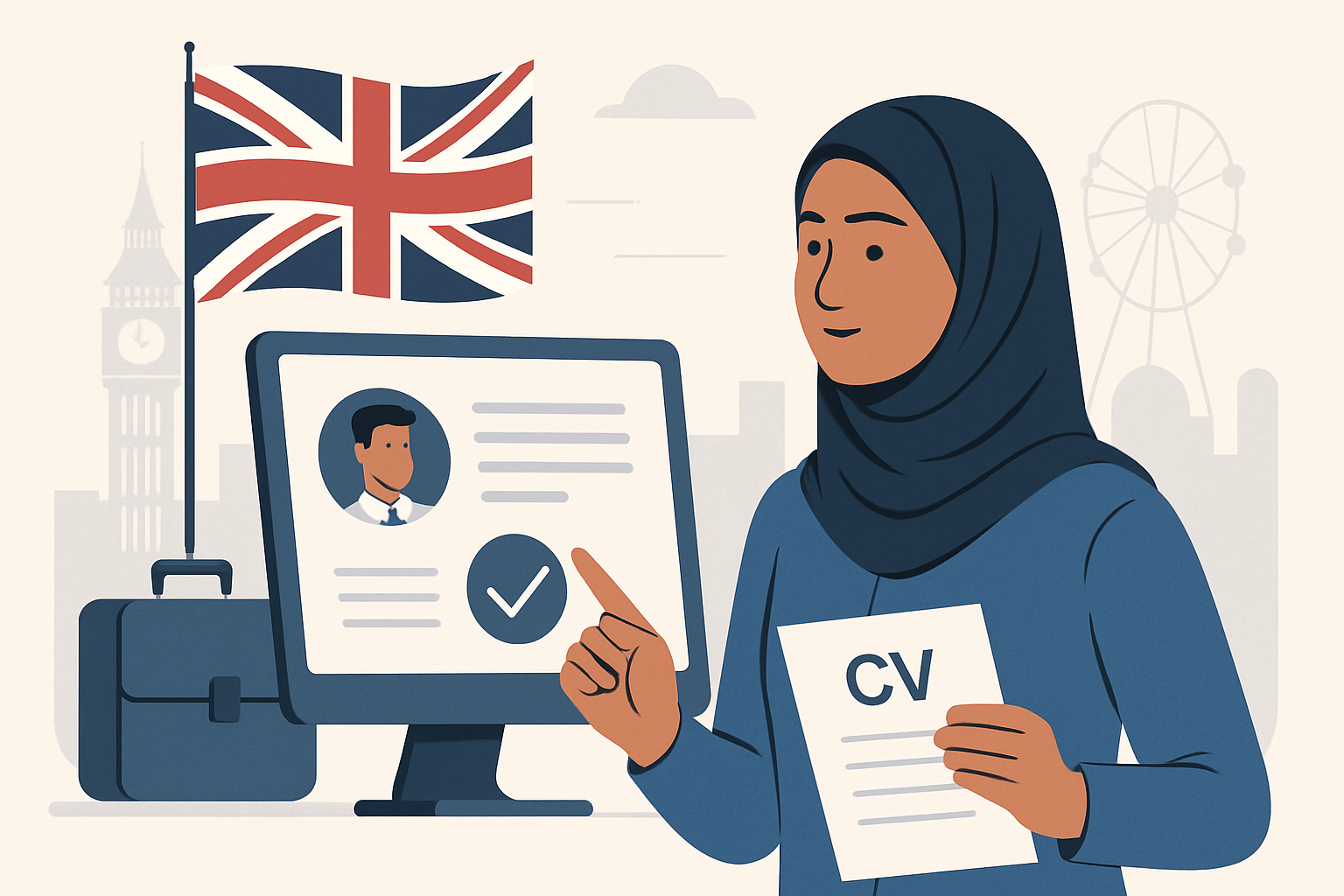
Getting a job in the UK in 2026 requires a targeted strategy: the right job boards, a two-page British-format CV with no photograph, strong competency-based interview preparation, and two professional references ready to go. This guide walks you through every step of the process. Related article
Key Takeaways
- UK employers expect a 2-page, photo-free CV in reverse chronological order — not a résumé or portfolio-style document.
- Reed, Indeed UK, Totaljobs, and LinkedIn are the four biggest general job boards; sector-specific boards matter for healthcare, law, and tech.
- Competency-based (“Tell me about a time when…”) interviews are the UK standard; prepare STAR-format answers.
- Most professional roles have 2–3 interview rounds; many include an online assessment or case study.
- Always prepare two professional references — in the UK, references are checked before the offer is confirmed, not after.
Step 1: Define Your Target Roles and Sectors
Before you start applying, spend time mapping the UK job market in your field. In 2026, the highest-demand sectors are:
- Technology: Software engineering, data science, cybersecurity, AI/ML
- Healthcare: Nursing, medicine, allied health professions
- Engineering: Civil, structural, aerospace, energy
- Finance: Investment banking, risk, compliance, accounting
- Education: Secondary teachers (STEM priority)
Use LinkedIn’s Salary Insights and the ONS (Office for National Statistics) Annual Survey of Hours and Earnings to benchmark realistic salary expectations before you apply.
Step 2: Use the Right UK Job Boards
| Platform | Best For |
|---|---|
| Reed.co.uk | Broad UK market, strong for office and professional roles |
| Indeed UK (uk.indeed.com) | Volume search across all sectors |
| Totaljobs.com | Mid-to-senior professional roles |
| LinkedIn Jobs | Networking-led search, senior and specialist roles |
| NHS Jobs (jobs.nhs.uk) | All NHS positions (required channel for NHS roles) |
| CWJobs / Jobsite | IT and technology roles |
| Guardian Jobs | Education, charity, public sector |
| CV-Library | Broad UK, strong regionally outside London |
| DrJobPro UK | International and Middle East–connected UK roles |
Always apply directly via the employer’s careers portal when you can — it reduces the risk of your application being filtered out by a third-party ATS before a human sees it.
Step 3: Write a UK-Format CV
A British CV follows specific conventions that differ from American résumés or Middle Eastern biodata formats:
Structure
- Contact details — name, phone, professional email, LinkedIn URL, town/city only (no full home address for privacy)
- Personal profile — 3–5 line summary of your experience, skills, and what you are looking for
- Work experience — reverse chronological, with bullet-point achievements using active verbs and quantified results
- Education — degrees and professional qualifications; school-leaving qualifications only if you lack a degree
- Skills — relevant technical and language skills, professional memberships
- References — “References available on request” is standard
Critical Rules
- No photograph — photographs are not used on UK CVs and can expose employers to discrimination claims
- No personal details — date of birth, marital status, nationality are not included
- Maximum 2 pages — two A4 pages for most roles; senior executives may extend to three
- Tailor for every application — match your profile and bullet points to each job description’s key words
Step 4: Write a Strong Cover Letter
UK cover letters are concise — typically three paragraphs, one page maximum:
- Opening: State the exact role you are applying for and where you saw it advertised.
- Middle: Explain why you are a strong fit, referencing two or three specific requirements from the job description with evidence from your experience.
- Closing: Express genuine enthusiasm for the company and invite them to contact you.
Address the letter to a named person where possible (“Dear Ms Smith”) rather than “To Whom It May Concern.” Check the LinkedIn profile of the hiring manager or HR contact.
Step 5: Navigate the UK Interview Process
Most UK professional roles follow this sequence:
Typical Interview Stages
| Stage | Format | Purpose |
|---|---|---|
| 1. Telephone / Video Screen | 20–30 min with HR or recruiter | Baseline screening, salary check |
| 2. First Interview | 45–60 min, usually with line manager | Competency and experience review |
| 3. Assessment / Task | Case study, presentation, or online test | Role-specific skills verification |
| 4. Final Panel Interview | 60–90 min, often with senior stakeholders | Culture fit and final assessment |
| 5. Reference & Offer | Verbal, then written offer letter | Offer confirmation |
Competency-Based Questions
UK interviewers rely heavily on competency-based questions. Use the STAR method:
– Situation — set the context
– Task — explain what you needed to do
– Action — describe your specific actions
– Result — quantify the outcome
Common themes: leadership, problem-solving, teamwork, handling conflict, meeting deadlines under pressure.
Step 6: Understand UK Employment Law Basics
Before you accept an offer, know your rights:
- Statutory minimum notice: 1 week per year of service (up to 12 weeks)
- Annual leave: 28 days minimum (including bank holidays) for full-time workers
- Probation period: typically 3–6 months; dismissal is easier during probation
- Pension auto-enrolment: employers must enrol you in a workplace pension; minimum employer contribution is 3% of qualifying earnings in 2026
- National Living Wage: £11.44/hour for workers aged 21+ (2024 rate; reviewed annually in April)
Step 7: Negotiate Your Salary
UK salary negotiation is generally lower-stakes than US negotiation culture — most offers have modest room to move (5–10%), but a reasonable counter-offer is accepted professionally. Always get the final offer in writing before resigning from a current role.
Find competitive UK roles across all sectors at DrJobPro UK Jobs.
Frequently Asked Questions
Q1: Do UK employers check the right to work before hiring?
Yes. UK employers have a legal duty to verify your right to work before your first day. You will need to show original documents (passport, BRP, visa, or share code) or complete an online right-to-work check via the Home Office portal. Employers who fail to do this face fines of up to £60,000 per illegal worker from 2024.
Q2: Should I include a photo on my UK CV?
No. Photos are not standard on UK CVs and are actively discouraged. Including one may give some employers concern that you are not familiar with UK hiring norms.
Q3: How long does the UK hiring process typically take?
For professional roles, the process from application to offer typically takes 3–8 weeks. Financial services and public-sector roles often take longer due to enhanced background screening. Tech firms at hyper-growth stage can move in 1–2 weeks.
Q4: Are UK cover letters always required?
Most UK job applications — especially for professional and management roles — expect a cover letter or a covering statement. Some online application forms replace the letter with a “personal statement” text field. In either case, tailor your response specifically to the role.
Q5: What references are expected in the UK?
UK employers typically request two references: your most recent manager and either a second recent manager or an academic referee (if you have recently graduated). References are usually checked after a verbal offer is made. You should always ask permission before listing someone as a referee.
Q6: Is LinkedIn important for getting a job in the UK?
Extremely. Approximately 80% of UK recruiters use LinkedIn to source candidates. A complete, up-to-date profile with a professional headshot, detailed work history, and skills endorsements significantly increases your visibility. Many UK roles are filled through recruiter InMail before they are ever advertised publicly.
Take the First Step Towards Your UK Career
The UK job market rewards preparation, specificity, and professional presentation. A tailored CV, well-structured STAR answers, and an active LinkedIn profile will place you ahead of most candidates. Browse verified UK job listings across every major sector at DrJobPro’s UK jobs board and start applying today.














