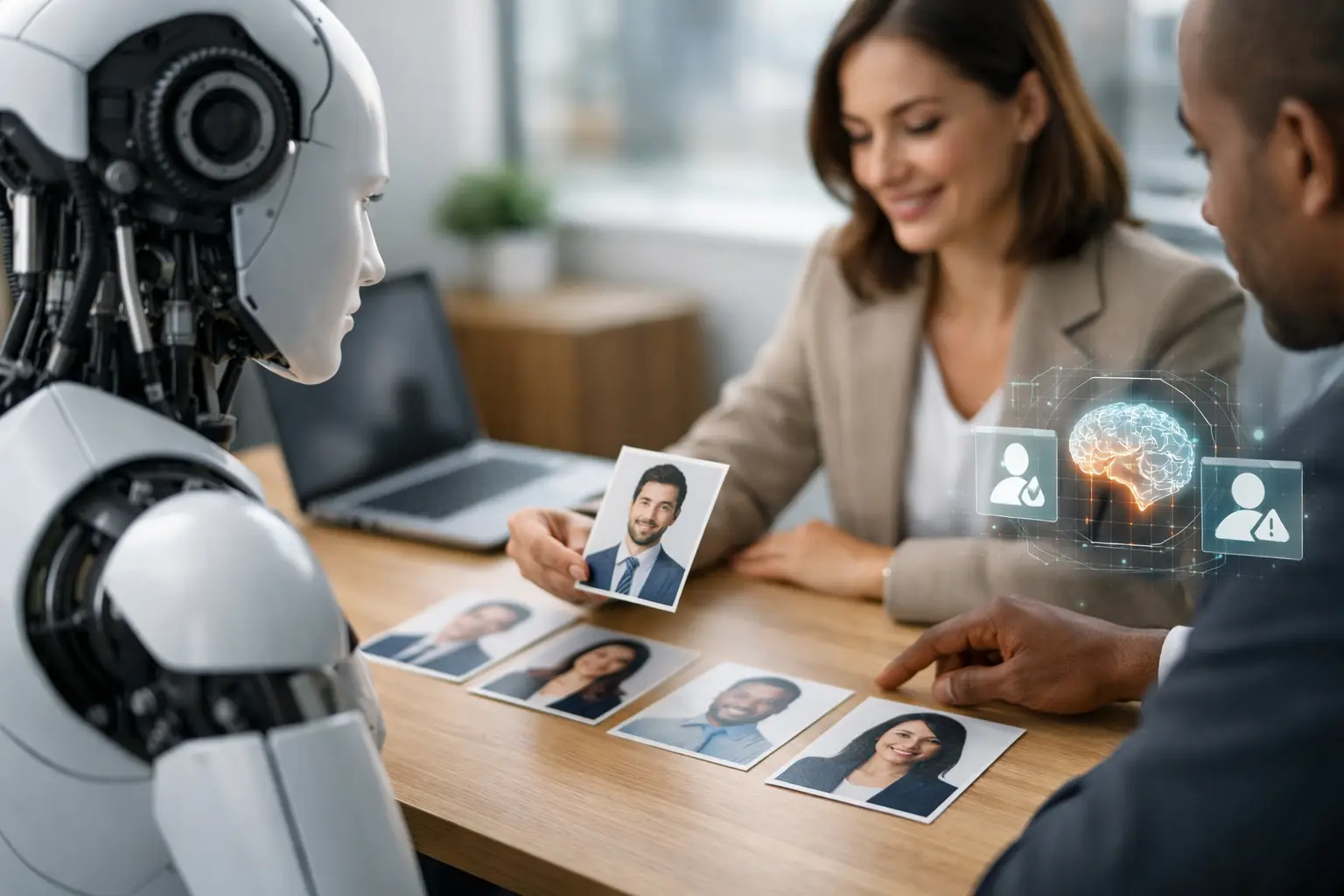

Can AI Reduce Hiring Bias at Scale?
A hiring team rejects a candidate in six seconds because the resume does not “feel right.” Another interviewer gives high marks to someone who shares their background, school, or communication style. Most bias in hiring does not arrive with a warning label. It hides inside rushed decisions, inconsistent scorecards, and fragmented workflows. That is why employers keep asking the same question: can ai reduce hiring bias?
The short answer is yes, but not by default.
AI can reduce hiring bias when it is used to standardize evaluation, remove noise from early-stage screening, and enforce consistent decision paths across the hiring process. It can also amplify bias when it is trained on flawed data, deployed without oversight, or layered onto a broken process. The difference is not the algorithm alone. It is the operating system around it.
Can AI reduce hiring bias in practice?
Related: How to Ace Remote Job Interviews: Complete Guide +
It can, if the goal is operational fairness rather than automation for its own sake.
Bias often enters hiring through variation. Different recruiters screen for different signals. Different managers ask different questions. Different interviewers score candidates against private criteria they never document. That inconsistency creates room for personal preference, assumptions, and pattern-matching that has little to do with job performance.
AI is useful here because it can force structure where hiring teams usually rely on instinct. It can rank applicants against defined job requirements instead of resume polish. It can route every candidate through the same screening workflow. It can present interviewers with the same competencies to assess. It can flag when feedback is vague, contradictory, or disconnected from the role.
Related: Interview Tips Saudi Arabia — 2026 Guide
That matters because bias is rarely a single bad actor problem. It is usually a process problem. When hiring runs across inboxes, spreadsheets, ATS records, job boards, and interview apps, consistency collapses. Once consistency collapses, fairness does too.
Where AI actually helps reduce bias
The biggest gains usually happen at the points where human judgment is fastest and least structured.
Resume screening
Manual resume review is one of the noisiest stages in hiring. Recruiters work under time pressure. They skim. They infer. They fill gaps with assumptions. Names, schools, previous employers, career breaks, location, and formatting can all shape perception before qualifications are seriously reviewed.
AI-based screening can narrow that exposure by evaluating candidates against skills, experience, certifications, and role-specific criteria in a standardized way. That does not mean removing humans from the process. It means removing arbitrary variation from the first pass.
The key is what the model is asked to optimize for. If it is told to find the “best fit” based on historical hires, it may replicate past bias. If it is built to assess candidates against explicit, job-relevant requirements, it has a better chance of improving fairness.
Structured interviewing
Interviews are where bias becomes expensive. Once a candidate reaches a live conversation, first impressions, affinity bias, and communication-style preferences can quickly outweigh evidence.
AI can improve this stage by enforcing structured interview design. That includes consistent questions, competency-based scorecards, and standardized feedback capture. Some systems can also analyze interview data for scoring anomalies, interviewer drift, or patterns that suggest one group is being evaluated differently from another.
This is not about replacing the interviewer. It is about tightening the system around the interviewer so that decisions are based on evidence, not chemistry.
Decision calibration
Bias often shows up after interviews, when the team meets to “compare notes.” Strong personalities dominate. Weak feedback gets reinterpreted. One person’s intuition can outweigh documented evidence.
AI can support calibration by organizing candidate data into comparable, role-specific views and surfacing decision criteria that have actually been met. It can identify when one candidate is being penalized for gaps that were ignored in another. It can also expose whether certain evaluators consistently score more harshly or favor a narrow candidate profile.
That kind of visibility is operationally valuable. You cannot fix bias you cannot see.
Where AI fails
There is a reason many employers are skeptical. They should be.
AI is not neutral. It learns from inputs, rules, and outcomes. If those inputs reflect biased hiring history, the system can reproduce that history at scale. If job descriptions are inflated or exclusionary, AI can screen against bad criteria more efficiently. If candidate evaluation data is inconsistent, the model will learn from noise.
There is also a second problem: false confidence. Teams often trust AI outputs because they look objective. A ranked list feels scientific. A match score feels precise. But if the model logic is weak, opaque, or poorly governed, that confidence becomes dangerous.
So the real question is not just can ai reduce hiring bias. It is: under what conditions does it reduce bias without creating a new layer of unaccountable decision-making?
The answer comes down to system design.
What employers should require from AI hiring systems
A bias-reducing hiring system should do more than automate tasks. It should create a controlled environment for fairer decisions.
First, it should anchor screening and evaluation to job-relevant criteria. Skills, experience, certifications, and demonstrated capabilities should outweigh proxies like pedigree or familiarity.
Second, it should standardize workflows across the hiring lifecycle. If every recruiter uses different filters and every interviewer uses different scorecards, AI cannot fix the underlying inconsistency.
Third, it should preserve auditability. Employers need to understand how candidates were evaluated, why recommendations were made, and where human overrides occurred. If there is no traceability, there is no accountability.
Fourth, it should support ongoing monitoring. Bias is not solved once at implementation. Employers need to review funnel conversion rates, selection patterns, interview scores, and offer outcomes across relevant groups over time.
This is where fragmented hiring stacks break down. One tool screens candidates. Another runs interviews. Another stores feedback. Another tracks offers. Data gets scattered, context gets lost, and governance becomes performative. Hiring teams cannot manage fairness at a system level if the system does not exist.
Bias reduction requires infrastructure, not point solutions
This is the part many vendors skip.
If your hiring process is spread across disconnected tools, AI will only optimize fragments. It might speed up sourcing while leaving interviews unstructured. It might score resumes while feedback still lives in email. It might automate scheduling while recruiters still rely on subjective notes to advance candidates.
That is not bias reduction. That is isolated automation.
To reduce bias meaningfully, employers need one operating layer across job creation, candidate sourcing, screening, interviews, pipeline movement, evaluation, and offer management. A unified system makes it possible to apply the same standards consistently, capture the right decision data, and monitor outcomes across the full funnel.
That is why AI-native recruitment infrastructure is gaining traction. It does more than save time. It gives hiring teams operational control over how decisions are made.
A platform like Dr.Job fits this model because it centralizes the hiring lifecycle instead of adding another disconnected tool. When screening logic, interview workflows, candidate records, and decision data live in one environment, teams can standardize evaluation and reduce the opportunities for hidden bias to enter the process. That is a system upgrade, not a feature upgrade.
What “good” looks like for leadership teams
For talent leaders and operations-focused employers, success is not a vague promise of fairer hiring. It is measurable.
Good looks like shorter time-to-review without greater candidate drop-off. It looks like tighter alignment between job requirements and shortlisted candidates. It looks like interview scorecards that are completed consistently and compared cleanly. It looks like fewer unexplained decision swings between recruiters, departments, or regions. And it looks like audit-ready hiring data that stands up to internal scrutiny.
There is still a role for human judgment. There should be. Hiring is not a math problem alone. But human judgment performs better inside a structured, evidence-driven system than inside a patchwork of subjective habits.
That is the real promise of AI in hiring. Not machine fairness as a magic trick. Structured fairness as an operational outcome.
So, can ai reduce hiring bias? Yes, when it is built into the workflow, tied to job-relevant criteria, and governed like business infrastructure. No, when it is treated as a black box layered onto a messy process.
The employers that benefit most will not be the ones chasing AI features. They will be the ones rebuilding hiring around consistency, visibility, and control. That is where bias starts to lose ground.