

- وظائف للأجانب في السعودية 2025 — الدليل الشامل
- Jobs in Saudi Arabia for Expats: The Complete 2025 Guide
- أعلى الرواتب في السعودية 2025 — دليل شامل بالأرقام الحقيقية
- Highest Paying Jobs in Saudi Arabia 2025 (With Real Salary Data)
- 9 Work From Home Application Tips That Work
Since the onset of the COVID-19 pandemic, Dubai has responded with swift and effective health measures and economic support initiatives that protected lives and livelihoods. This has enabled the Emirate to contain the spread of the Covid-19 virus and its impact on the economy, and paved the way for a quick recovery. The comprehensive preventive and support measures were implemented following the directives of His Highness Sheikh Mohammed bin Rashid Al Maktoum, Vice President and Prime Minister of the UAE and Ruler of Dubai, and the close follow-up of HH Sheikh Hamdan bin Mohammed bin Rashid Al Maktoum, Dubai Crown Prince and Chairman of The Executive Council of Dubai whose leadership of the crisis became a global role model for combating COVID-19.
Following the outbreak of the pandemic, Dubai Government stepped up its efforts in monitoring market conditions and communicating with the private sector and the broader community. The Government adopted strong precautionary protocols to safeguard public health and ensure business continuity. This approach enabled a faster return to normal life and the resumption of economic activity in record time on the basis of real time data and analysis.
HE Sami Al Qamzi, Director General of Dubai Economy stated: “Our leadership’s directives were focused on ensuring that the short-term impact of the COVID-19 pandemic does not translate into a long-term economic hardship that would inflict lasting damage on people and businesses by way of job losses and bankruptcies.” This has paved the way for Dubai to be one of the very first cities to gradually reopen its markets and businesses. Under the directives of HH Sheikh Mohammed bin Rashid Al Maktoum, Dubai was a pioneer in launching initiatives to overcome challenges faced by individuals and businesses, which had a significant positive impact on minimizing the economic impact of the pandemic, His Excellency added.
Dubai Economic Outlook 2020-2021
During the period between March and October this year, the Government of Dubai launched four stimulus packages with the objective of mitigating the impact of confinement measures in the Emirate, on the demand side, covering consumption, investment, trade and travel, as well as on the supply side including the workforce, supply chains and the cost of doing business. The initiatives, worth around AED6.8 billion, helped offset the shock and repercussions in the form of job losses or disruptions to businesses.
According to a recent study by Dubai Economy, Dubai’s stimulus packages contributed to reducing the economic impact of the crisis by limiting the expected economic contraction to -6.2% in 2020, a decline that is in line with the growth outlook of countries around the globe as reported by the International Monetary Fund (IMF, Table 1).
Table 1: IMF Economic Outlook 2020
-9.8% United Kingdom
-8.3% Eurozone
-7.1% Canada
6.6% – UAE
5.4% – Saudi Arabia
5.3% – Japan
4.3% – United States
Source: International Monetary Fund – World Economic Outlook, October 2020
The precautionary and preventive measures adopted to contain the COVID-19 pandemic in Dubai, along with travel restrictions around the world, had a severe impact on hotels and restaurants, which are expected to see a contraction of -20% in 2020 (Figure 1). Also affected were the transport and storage sector (-11 %), and the retail and wholesale trade sector (-9%).
- Expert-backed insights updated for 2025
- Actionable steps you can apply immediately
- Data-driven advice from DrJobPro hiring trends
Last Reviewed: April 2026 | Sources: DrJobPro Hiring Data Q1 2026.
Fintech companies maintained their position as a major growth driver, with 87 companies specialised in financial technology joining DIFC’s innovation and technology excellence system, increasing the number of registered and licensed financial technology companies by 74% compared to H1 2019. H1 2020 also witnessed a threefold increase in the size of the financial technology accelerator ‘Fintech Hive’ in the financial centre with the opening of new and large spaces at Gate Avenue to support start-ups and entrepreneurs. DIFC achieved a record number of applications to participate in the fourth edition of Fintech Hive. In 2020, the programme received more than 600 applications from emerging companies operating in various sectors, including organisational technology, Islamic financial technology, insurance technology and various financial technology sectors, representing a 46% increase compared to last year.
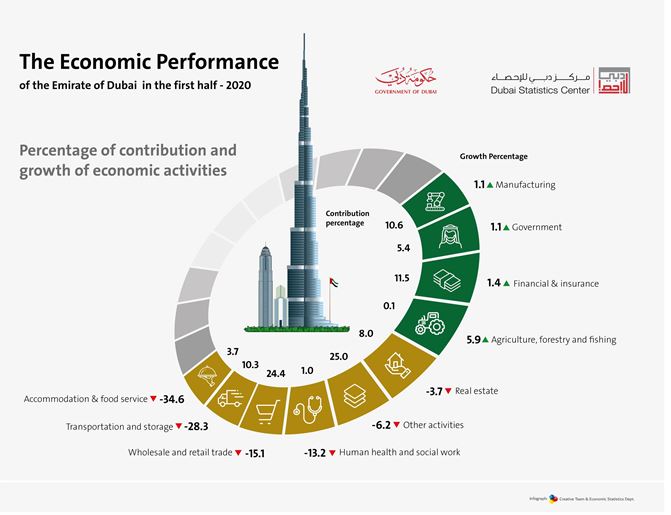
Productive activities (agriculture, mining, and industry), which are critical to securing the needs of residents and businesses, grew by 1% in the first half of 2020. These sectors remained active under close monitoring and stringent observance of precautionary measures.
The government sector achieved a growth rate of 1.1% in the first half of the year compared to the same period last year, contributing 5.4% to the emirate’s real GDP and pushing its economy up by 0.1 percentage point, as it continued spending on development projects. Total government spending grew by 6% in H 2020 compared to the first half of the previous year.
For a dream career in Dubai, Click here!
Frequently Asked Questions
What is the key insight on Dubai Economy expected to grow by 4% in 2021: Report?
This guide is based on current DrJobPro hiring data and regional labour market research updated for 2025.
How do I find relevant jobs?
Browse DrJobPro at drjobpro.com/jobs — filter by location, salary, and experience level.
Is this advice current for 2025?
Yes. All data is reviewed quarterly using live hiring data from DrJobPro.














