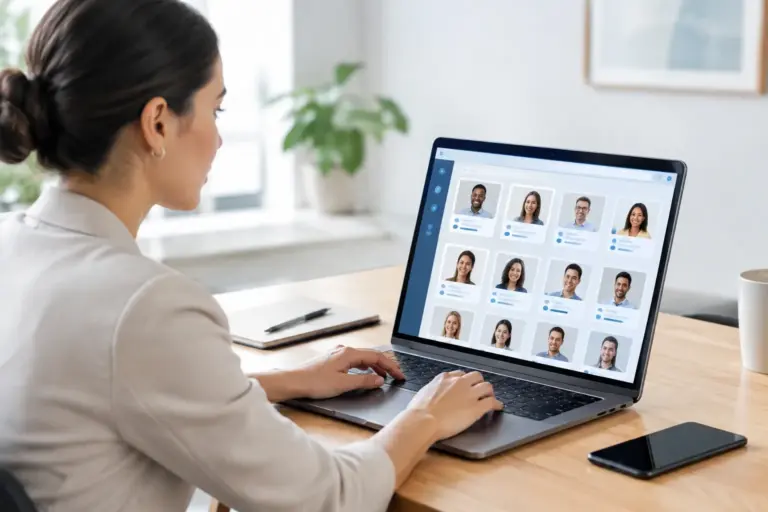

A qualified candidate can disappear in the time it takes a recruiting team to compare notes, chase a hiring manager for availability, and send three follow-up emails. The question is not whether how AI can help employers move faster from shortlist to interview matters. It is whether your hiring operation can afford to let manual handoffs set the pace.
Most hiring delays do not begin with a lack of applicants. They begin after the shortlist is built. Candidate data sits in one system, interview feedback lives in another, calendars create friction, and nobody has a complete view of what needs to happen next. AI changes this by turning the shortlist-to-interview stage from a chain of disconnected tasks into an orchestrated workflow.
Hiring needs infrastructure, not more tools.
Why the Shortlist-to-Interview Stage Breaks Down
A shortlist should signal momentum. Too often, it creates a bottleneck. Recruiters have already invested time in sourcing and initial qualification, but moving candidates forward still depends on manual review, scattered communication, and delayed decisions from busy stakeholders.
The issue is not that any one task is difficult. It is that every task requires a context switch. A recruiter exports candidate details from an applicant tracking system, sends a summary by email, waits for feedback, checks calendars, then manually updates the pipeline. Multiply that process across open roles, interviewers, locations, and time zones, and speed becomes impossible to manage consistently.
This fragmentation also creates a decision-quality problem. When hiring managers receive incomplete candidate context or review profiles at different times, evaluation becomes inconsistent. Strong candidates may wait because the process is disorganized, not because the team needs more evidence.
AI should not simply make individual tasks faster. It should remove the operational gaps between them.
How AI Moves Candidates From Shortlist to Interview
The highest-value use of AI in recruiting is workflow acceleration with human accountability. AI can organize information, identify priorities, trigger actions, and surface decision-ready insights. Recruiters and hiring managers remain responsible for judgment, fit, and final selection.
AI creates a sharper, more defensible shortlist
A traditional shortlist is often based on resume review alone. That approach is slow, vulnerable to inconsistency, and limited by the time a recruiter has available. AI-driven screening can assess candidate profiles against the role’s required skills, experience, location, work authorization, compensation range, and other defined criteria.
The result is not an opaque ranking that tells teams whom to hire. It is a structured view of why candidates match the role, where gaps exist, and which applicants deserve immediate attention. Recruiters can spend less time sorting records and more time validating the people most likely to succeed.
This distinction matters. A fast process that advances the wrong candidates only moves failure earlier. The goal is to reduce administrative delay while preserving the quality controls that protect hiring outcomes.
AI turns candidate information into interview-ready context
Hiring managers should not need to reconstruct a candidate’s story from a resume, an email thread, and recruiter notes. AI can summarize relevant qualifications, screening responses, key skills, career patterns, and role-specific signals in a consistent format.
That gives every interviewer a clearer starting point. Instead of asking recruiters, “Why is this person on the shortlist?” hiring managers can review the evidence directly and make a faster decision about whether to interview.
Standardized context also improves fairness. Each shortlisted candidate can be presented against the same criteria, rather than receiving a different level of detail based on who reviewed their profile or how much time the team had that day.
AI automates the next action, not just the analysis
Insight without execution does not reduce time-to-hire. The real operational shift happens when AI connects screening results to the next workflow step.
When a candidate meets the defined threshold, the system can prompt the recruiter to advance them, request hiring manager review, send an interview invitation, or trigger scheduling based on approved rules. If feedback is overdue, it can flag the delay before the candidate goes cold. If a role has priority candidates waiting, it can surface that queue to the people responsible for action.
This is where fragmented recruiting stacks fail. One tool may score a candidate, another may hold the calendar, and a third may store the pipeline status. The recruiter becomes the integration layer. In an AI-native recruitment operating system, the workflow itself carries the candidate forward.
AI reduces scheduling friction at scale
Scheduling is one of the most visible sources of candidate frustration and one of the least strategic uses of recruiter time. Coordinating availability across hiring managers, panel interviewers, and candidates can consume days, especially in high-volume or distributed hiring.
AI-supported scheduling can identify available time slots, issue invitations, manage confirmations, and keep interview stages moving without a recruiter manually coordinating every exchange. Native video interviewing adds another advantage: the candidate record, interview event, scorecards, and feedback stay connected in the same operating environment.
Speed should not mean forcing candidates into a rigid process. For executive hiring, highly specialized roles, or situations requiring a personal touch, recruiters may choose to manage scheduling directly. Automation should handle repeatable coordination while leaving room for judgment and relationship-building where it matters.
The System Upgrade: One Workflow, One Source of Truth
The strongest AI recruiting outcomes do not come from adding a standalone assistant to an already fragmented stack. They come from unifying the workflow that produces the decision.
When job posting, sourcing, candidate screening, pipeline management, interview scheduling, video interviews, feedback, offers, and compliance exist in separate tools, every handoff creates delay and data loss. Teams duplicate information, rely on spreadsheets to track progress, and spend too much time asking for status updates.
A unified Recruitment Operating System changes the model. Candidate data is captured once and used throughout the hiring lifecycle. Screening informs pipeline movement. Pipeline movement triggers interview workflows. Interview feedback informs the decision. Approved candidates can move into offer generation and e-signature workflows without restarting the process in another platform.
Dr.Job is built around this operational model: one AI-powered environment that runs recruitment from first touch to signed offer. This is not a tool upgrade. It is a system upgrade.
Where Employers Should Keep Humans in Control
AI can accelerate the path to an interview, but it should not independently define what great talent looks like. Employers must establish the criteria AI uses, review recommendations, and monitor outcomes for consistency and fairness.
A practical operating model gives AI responsibility for high-volume, rules-based work: profile matching, data extraction, candidate summaries, workflow reminders, scheduling coordination, and status management. Recruiters and hiring managers own the work that requires business judgment: calibrating role requirements, assessing motivation, probing for context, and making final decisions.
This balance is especially important when a role relies on qualities that are difficult to infer from structured data alone. Leadership potential, team dynamics, unusual career transitions, and mission alignment may require more nuanced human evaluation. AI can prepare the team for that conversation. It should not replace it.
Metrics That Show Whether AI Is Actually Creating Speed
Do not measure success by the number of automated actions. Measure the time and quality gained between shortlist creation and completed interviews.
Start with the median time from shortlist to interview invitation and from invitation to completed interview. Then look at hiring manager review time, candidate response time, interview no-show rates, and the percentage of shortlisted candidates who move forward. These measures reveal whether the process is truly accelerating or simply moving bottlenecks downstream.
Also track candidate experience. Faster communication, fewer reschedules, and clearer next steps are not cosmetic improvements. They directly affect offer acceptance, employer reputation, and the likelihood that top talent remains engaged.
The best signal is operational clarity: can your team see exactly which candidates are waiting, who owns the next action, and why a decision has not moved forward? If the answer is no, the workflow is still carrying too much manual friction.
Build Speed Into the Process, Not Around It
Employers do not lose great candidates because recruiters lack effort. They lose them because the operating model asks people to bridge disconnected systems, chase routine approvals, and manually coordinate work that technology can manage.
AI gives hiring teams the ability to make the shortlist meaningful again: a moment when qualified candidates move forward with context, urgency, and control. The organizations that hire faster will not be the ones that add the most AI features. They will be the ones that build a hiring system where the next right action happens before momentum is lost.